Thursday, December 3, 2020

Herzberg’s two-factor theory


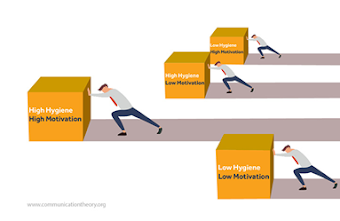
Herzberg’s two-factor theory was first published in 1959 based on two hundred engineers and accountant feedback and it was mainly focused on the individual in the workplace, but the theory has been popular among the manager as it also emphasized the important knowledge and experience (John Adair, 2009). There are two factors that effected on job satisfaction which is the motivation factor and the hygiene factor are the main concept of this theory (Alshmemri, Shahwan-Akl, and Maude, 2017). When it considered  individual job satisfaction  Hygiene factors are more important than  motivation factors (Alshmemri, Shahwan-Akl, and Maude, 2017)

This theory is very closely related to Maslow's Hierarchy of Needs theory. It introduced more factors and details to measure how individuals are motivated in the work environment than Maslow’s hierarchy of needs (Fauziah et al., 2013). The Presence of motivational factors can produce job satisfaction and if it is absent leads to no job satisfaction but a poor hygiene factor can cause job dissatisfaction (Alshmemri, Shahwan-Akl and Maude, 2017). 


Figure 1: Different views between traditional motivation and Herzberg’s two-factor theory.

                                                                                                            (Chu and Kuo, 2015)

According to Yousaf (2020) Motivation factors are,

  • Advancement
  • Work itself
  • Possible of growth
  • Responsibility
  • Recognition
  • Achievements 

And the Hygiene factors are, 

  • Interpersonal relationship
  • Salary
  • Policies and administration
  • Supervision
  • Working condition
  

Table 1: Comparisons between the Two Factors of Herzberg’s Theory                                                                                                        (Alshmemri, Shahwan-Akl and Maude, 2017)


In one of the organizations which I worked for leading IT support services providing, the facilities provided by the organization management,


Motivational factors

All employees get an extra amount of money through an incentive scheme based on the department's performance. The organization held the recognition program to motivate their employees such as Engineer of the month, helpdesk coordinator of the month. It was a good working environment to work and employees get the chance to implement their own ideas.


Hygiene Factors

It was introduced a new helpdesk system and helps to efficient all works. Supervisors have good relationships with their subordinates. It provides a good working condition and some other facilities such as food allowance, transport, medical coverage. For minor staff members get special school books for his/ her kids. 


References:


Alshmemri, M., Shahwan-Akl, L. and Maude, P. (2017) ‘Herzberg’s two-factor theory’, Life Science Journal, 14(5), pp. 12–16. doi: 10.7537/marslsj140517.03.Keywords.

Chu, H.-C. and Kuo, T. Y. (2015) ‘Testing Herzberg’s Two-Factor Theory in Educational Settings in Taiwan’, The Journal of Human Resource and Adult Learning, 11(1), pp. 54–65. Available at: http://www.hraljournal.com/Page/10 HuichinChu&TsuiYangKuo.pdf.

Fauziah, W. et al. (2013) ‘HERZBERG ’ S TWO FACTORS THEORY ON WORK MOTIVATION : DOES ITS WORK FOR TODAYS ENVIRONMENT ?’, 2(5), pp. 18–22.

John Adair (2009) ‘Frederick Herzberg: Hygiene Motivation Theory thinker’, Chartered Management Institute, pp. 1–4. Available at: https://www.bl.uk/people/frederick-herzberg.

Yousaf, S. (2020) ‘Dissection of Herzberg ’ s Two -Factor Theory to Predict Job Satisfaction : Empirical Evidence from the Telecommunication Industry of Pakistan’, 2(Spring), pp. 85–128.


Monday, November 30, 2020

Maslow's Hierarchy of Needs


Maslow's hierarchy of needs was explained by Abraham Maslow in his 1943 paper "A Theory of Human Motivation". It’s a theory of psychology anticipate (Jerome, 2013) Prior to Maslow, researchers were generally focused on factor such as biology, achievement, or power to explain what energizes, directs, and sustains human behavior separately (Huitt, 2007) Maslow's hierarchy of needs posited two basic groupings of the human hierarchy needs which were deficiency needs and growth needs (Huitt, 2007). When Considering about the deficiency needs each lower level need to fulfill before moving to the next higher level (Uysal, Aydemir and Genc, 2010).

According to the Huitt (2007) deficiency needs are,

  1. Physiological: hunger, thirst, bodily comforts
  2. Safety/security: out of danger
  3. Belongingness and Love: affiliate with others, be accepted; and
  4. Esteem: to achieve, be competent, gain approval and recognition.

According to Maslow's hierarchy of needs deficiency needs must be satisfied before person can their potential and self-actualize (McLeod, 2007). Self-realization is an individual's effort to empower himself, develop skills, and reach the ideal person  wants to be (Tezcan Uysal and Genç, 2017). Leading to this topic model was created a visualization in the shape of pyramid divided in to five levels (Benson and Dundis, 2003).Individual moves to self-actualization level it emphasized the meaning to life that is important to them (McLeod, 2007).  


Figure 1 : Maslow’s Hierarchy of Needs Pyramid (Tezcan Uysal and Genç, 2017)


The bottom of the pyramid is the human Physiological level includes food, water, and shelter which most basic level for humans. Survival is the most basic needs and when the physiological level has been met, the individual moved to the safety level (Benson and Dundis, 2003). In the safety level individual seek to be assisted in seeing the way can be safe and secure (Huitt, 2007).  Once the Individual fulfill the safe level next two levels accordingly Love and belonging as well as esteem (Benson and Dundis, 2003).

Video 1: www.khanacademy.org                                                 (Desai, 2013)


In the business perspective, this model can be approached for understanding the motivation of employee (Benson and Dundis, 2003). According to my personal experience, most of the organization provide benefits for non-managerial level such a vehicle or Vehicle allowance, foreign travels, entertainment facilities to motivate and retain their employees by maintaining esteem level. Conversely, Salary, allowances, and overtime are the physiological level require for day to day life needs and all individuals worry about job security is the security level seems the safety level of the model. On the other modern organization providing health insurance and it feels employee to more safe for his/her life. Further modern organization’s management respect employee’s ideas and treat them as a partner of the decision maker. It makes them as a part of the team and it seems the love and social need level.  

According to Jerome (2013) Maslow describes self-actualization as a person's need to be and do that which the person was "born to do." "A musician must make music, an artist must paint, and a poet must write." These needs make themselves felt in signs of restlessness. My idea is from the business perspective organization provides special training, moves individuals to special projects, and granted freedom for innovation provided by the management is the self-actualization level. 


References:

Benson, S. G. and Dundis, S. P. (2003) ‘Understanding and motivating health care employees: Integrating Maslow’s hierarchy of needs, training and technology’, Journal of Nursing Management, 11(5), pp. 315–320. doi: 10.1046/j.1365-2834.2003.00409.x.

Desai, S. (2013) Maslow’s hierarchy of needs, khanacademy. Available at: https://www.khanacademy.org/test-prep/mcat/behavior/theories-personality/v/maslow-hierarchy-of-needs.

Huitt, W. (2007) ‘Maslow ’ s Hierarchy Maslow ’ s Hierarchy of Needs’.

Jerome, N. (2013) ‘Application of the Maslow’s hierarchy of need theory; impacts and implications on organizational culture, human resource and employee’s performance’, International Journal of Business and Management Invention ISSN (Online, 2(3), p. 23198028.

McLeod, S. A. (2007) ‘CT2 Paper 1 Maslow’s Hierarchy of Needs’, Simply Psychology, 1(1), pp. 1–8.

Tezcan Uysal, H. and Genç, E. (2017) ‘Maslow ’ S Hierarchy of Needs in 21St Century : the Examination of’, Researches on Science and Art in 21st Century Turkey, (April 2018), pp. 211–227.

Uysal, H. T., Aydemir, S. and Genc, E. (2010) ‘Maslow ’ S Hierarchy – 21St’, (April), p. 211.


Sunday, November 29, 2020

Impact of Employee Motivation

Heart of the organization are an employee and In order for an organization to operate smoothly and uninterrupted, employee cooperation cannot be replaced by anything else (Nurun Nabi et al., 2017). Employee motivation plays an important role in the field of management both theoretically and practically (Nurun Nabi et al., 2017) Capacity and motivation is needed for efficient organizational performance since that organizational efficiency involves staff ready to conduct, and not only voluntarily, but also skilled in any organizational activity (Lyimo, 2019). Organization management should treat employees as their most valuable asset, and in order to get the best and highest out of this valuable asset, management needs to know what motivates them as much as employees give. The best thing for the organization (Vaněk et al., 2012).

According to Heryati (2020), Benefits of Motivated Employees as follows,

·         Increased employee commitment.

·         Improved employee satisfaction.

·         Improved employee efficiency.


And Employee motivation increase by,


·         Improve Positive Communication.

·         Value individual contribution.

·         Positive workplace environment.   

The employee performance level is basically related to the three key fundamental factors: (1) knowledge and skills, (2) workplace and organization conditions, (3) motivation (Vaněk et al., 2012). Motivation encourages employees internally to take action that will help them achieve the required task employ effectiveness is a way which can inspire people to their work and can bring more work motivation to the commitment of their jobs (Saleem, Mahmood and Mahmood, 2010). Motivated employees focused on define goals and objectives that employees must achieve, therefore, it directs the effort in that direction (Manzoor, 2011).

Well-motivated employees are one of the assets to the organization, write the success of organization (D. Lowe, 2017). Motivation is a the process that initiates through a physiological or psychological want that stimulates a performance that is intended at object goals (Manzoor, 2011).


Motivational Theories

According to Varma (2017), There are  numbers of theories on motivation explaining,

Those are,

·         Maslow’s need hierarchy theory.

·         Herzberg’s two-factor theory.

·         McGregor’s theory ‘x’ and theory ‘y’

·         Vroom’s valence x expectancy theory.

·         Goal-setting theory.

·         ERG theory of motivation.

·         McClelland’s theory of needs.

·         Reinforcement theory of motivation.

·         Equity theory of motivation


References:

D. Lowe,  networking for dummies (10th E. (2017) ‘About the Tutorial Disclaimer & Copyright’, Organizational Behavior, pp. 1–305. Available at: https://www.tutorialspoint.com/asp.net/asp.net_tutorial.pdf.

Heryati, R. (2020) Why Employee Motivation Is Important (& How to Improve It), 6Q. Available at: https://inside.6q.io/employee-motivation-important/.

Lyimo, B. J. (2019) ‘Impact of Motivation on the Employee Performance , a Case Study of Zanzibar Airports Authority’, 2(3).

Manzoor, Q.-A. (2011) ‘Impact of Employees Motivation on Organizational Effectiveness’, Business Management and Strategy, 3(1), pp. 36–45. doi: 10.5296/bms.v3i1.904.

Nurun Nabi, M. et al. (2017) ‘the Impact of Motivation on Employee Performances: a Case Study of Karmasangsthan Bank Limited, Bangladesh’, International Journal of Business and Management Review, 5(4), pp. 57–78. Available at: www.eajournals.org.

Saleem, R., Mahmood, Azeem and Mahmood, Asif (2010) ‘Effect of Work Motivation on Job Satisfaction in Mobile Telecommunication Service Organizations of Pakistan’, International Journal of Business and Management, 5(11), pp. 213–222. doi: 10.5539/ijbm.v5n11p213.

Vaněk, M. et al. (2012) ‘Employee motivation and benefits in industrial regions of the Czech Republic’, 12th International Multidisciplinary Scientific GeoConference and EXPO - Modern Management of Mine Producing, Geology and Environmental Protection, SGEM 2012, 1(June 2012), pp. 571–578. doi: 10.5593/sgem2012/s03.v1022.

Varma, C. (2017) ‘Importance of Employee Motivation & Job Satisfaction for Organizational Performance’, International Journal of Social Science & Interdisciplinary Research, 6(2), pp. 10–20.